All topics
The network drive
Files and websites
Cameras and sensors
A Stand for the Server
A phone lying flat serves files just fine, but its cameras stare at the shelf and the ceiling. These 3D-printable stands hold the phone upright while it charges and set how far its camera looks down into the room.
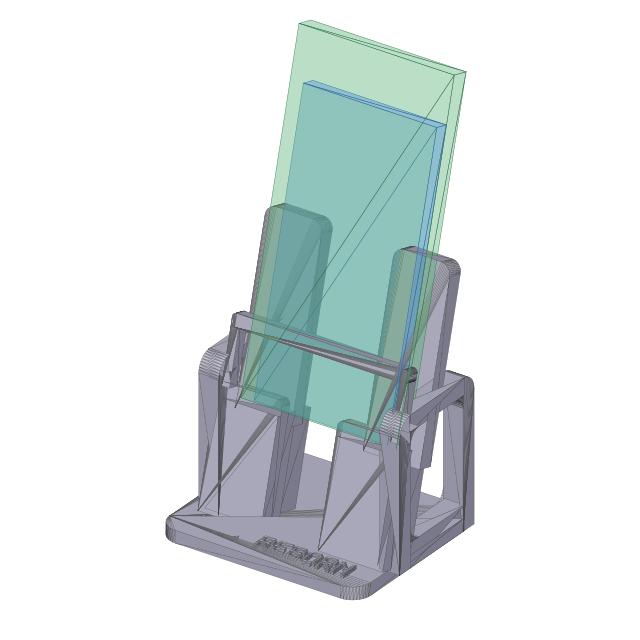
How it holds the phone
The phone slides in upright and leans back against two rails. Its bottom edge rests on two ledges with a wide gap between them, so the charging plug hangs freely into an open well and the cable leaves through the back of the base. Lightning and USB-C both fit, and you can lift the phone out without unplugging anything.
Nothing covers the buttons, the microphone, the speaker, either camera or the screen: the phone is held by a low chin that ends below the glass, so the whole interface stays visible and touchable, and a gap in the chin frames the home button. The sides are open frames rather than solid walls, so air moves around a device that is busy around the clock.
Which file to print
The recline decides where the rear camera looks when the back of the stand faces the room. 8° is close to level and suits an eye-height shelf, 15° is the safe middle, and 25° suits a high shelf watching the room below.
- Fitted to the iPhone 6s: 8°, 15°, 25°
- Any iPhone, from the SE up to the Max bodies, bare or in a thin skin: 8°, 15°, 25°
A 6s in the universal stand gets a few millimetres of play while the fitted one holds it without wiggle behind a chin that uses nearly the full height of the bezel. The universal stand braces the phone with a bridge that crosses the screen a little above the tab bar instead, high enough to clear the taller tab bar of home button models too, and the phone still drops straight into the slot behind it. In both cases the phone leans on the same back face, so the angle stays true.
Printing
Print the file as it is oriented, with the flat side on the bed, and no supports are needed. Three walls and 10 to 15 percent infill are plenty and come to between 75 and 100 grams of filament depending on the variant. PETG keeps its shape a little better than PLA against a phone that stays warm, but PLA works. For a two-colour print you add a filament change at the 6 mm mark, so the base prints in one colour and the uprights and the embossed lettering in the other.
Changing the design
Tinkercad can import the files, where you choose millimetres when asked, and you can then cut, extend or merge them like any other shape. A stand for a phone in a thick case does not have to start from scratch.